
Search New Jersey Death Records
New Jersey death records date back to May 1848, when the state became one of the first in the nation to require vital record registration. The New Jersey Department of Health maintains death records from 1951 to present. The New Jersey State Archives holds older death records on microfilm going back to 1848. You can search New Jersey death records through online databases, by mail, or in person at the walk-in center in Trenton. Local municipal registrars across all 21 counties also maintain death records for events in their towns. This page covers all the ways to find and obtain New Jersey death records.
New Jersey Death Records Quick Facts
Where to Find New Jersey Death Records
Two main offices hold New Jersey death records. The Office of Vital Statistics and Registry keeps death records from 1951 to present. This office is part of the New Jersey Department of Health. They issue both certified copies and certifications of death records. Certified copies have a raised seal and are printed on state safety paper. Certifications are plain paper copies that work for genealogy but not legal use. Certifications of death records do not contain the Social Security Number or cause of death.
The New Jersey State Archives is the second major source. Located at 225 West State Street in Trenton, the State Archives holds death records from 1848 through 1963 on microfilm. Their searchable databases contain over 2,350,000 entries. The Archives has a dual mission: to preserve New Jersey public records and to give the public access to them. Current holdings amount to over 37,000 cubic feet of paper records and more than 32,000 reels of microfilm. Records date from 1664 to present.
You can also get New Jersey death records from local municipal registrars. Each town has a registrar who keeps records of deaths that took place there. Under N.J.S.A. 26:8-25, the local registrar must enforce laws on the disposal of dead bodies and registration of vital records. They examine each certificate, make copies, and send originals to the State registrar.
Note: New Jersey death records are not public records and cannot be searched online through the state health department.
How to Search Death Records in New Jersey
The New Jersey Death Index is a free online database. It contains 1,275,833 death records from 2001 through 2017. The site also has over 500,000 digitized images of the death index for years 1901 to 1903, 1920 to 1929, and 1949 to 2000. This database was created by Reclaim The Records, a non-profit that uses Freedom of Information requests to make public records available. All search fields are optional. You only need to fill in what you know about the person.
The search tool has helpful features. Soundalike surnames and spelling variants are searched automatically. Common nicknames are included too. A search for "Bill" will also find William, Will, and Billy. You can use an asterisk as a wildcard for partial names. Only the top matches from the first 250 results will show.
The State Archives databases provide another way to search. Two main death record databases are available. The first covers May 1848 through May 1878 and has over 301,128 records. The second covers June 1878 through December 1900 with 628,584 records. You can search by name, county, and year range. Results are limited to 500 records per search. You can order copies directly from search results by adding them to a cart.
For records from 1951 forward, you must order from the Office of Vital Statistics. You can order through VitalChek online, by calling 877-622-7549, or by visiting the walk-in center at 140 E. Front Street in Trenton. Same day service is available for walk-in requests. Mail requests go to P.O. Box 370, Trenton, NJ 08625-0370.
Types of New Jersey Death Records
A death certificate is the official record of death in New Jersey. It identifies personal information of the deceased and the date, time, location, and cause of death. The document is signed by the physician certifying the death, the funeral director completing the information, and the registrar authorized to receive the death record. The New Jersey Funeral Directors Association provides guidance on how death certificates work.
New Jersey offers two types of copies. Certified copies have the raised seal and are printed on safety paper. They can establish identity and serve as legal documents. Certifications are issued on plain paper with no seal. They state clearly that they are not valid for identity or legal purposes. Certifications are useful mainly for genealogy research. They do not include the Social Security Number or cause of death medical terminology.
Death records in New Jersey contain the following information:
- Full name of the deceased
- Date, time, and place of death
- Cause of death
- Names of parents and spouse
- Burial location
- Age at time of death
An Apostille Seal is an additional seal needed for certain certified death records that will be presented to a foreign government. The foreign country must be a member of the Hague Treaty. You can request an Apostille through the state ordering portal.
Who Can Get Death Records in New Jersey
New Jersey law protects and restricts the release of vital records. Not just anyone can get a certified copy of a death record. The state follows Executive Order No. 18, which limits who may receive certified copies. Only certain people qualify.
Certified copies of New Jersey death records may be issued to the following:
- Parent, legal guardian, or legal representative of the deceased
- Spouse or civil union partner of the deceased
- Child, grandchild, or sibling of the deceased if of legal age
- State or federal agency for official purposes
- Any person pursuant to a court order
You must submit proof of your identity and proof of your relationship to the person named on the record. If your name changed due to marriage, include a copy of your marriage certificate. Genealogy certifications are easier to get. They are available for records that are 40 or more years old. These contain less detail but can help with family history research in New Jersey.
Note: No one can verify the existence of a death record or what it contains over the phone or by email in New Jersey.
New Jersey Death Records Fees
The Office of Vital Statistics has set fees for death record copies. The initial search and one certified copy or certification costs $25. Each additional copy of the same record ordered at the same time costs $2. For genealogy records only, additional years searched cost $1 per year. Make checks or money orders payable to "Treasurer, State of New Jersey." Do not send cash.
VitalChek charges extra fees for processing. Mail orders cost $6 in processing fees. Phone orders cost $12.95. Optional UPS tracking inside the continental United States adds $18. International shipping fees vary.
Local registrars set their own fees. Most charge $25 for the first copy. Some towns charge $10 for additional copies in the same transaction. You can also get death certificates through a funeral director when making arrangements. Contact your local registrar to confirm current fees. Cash, check, or money order is accepted at most local offices.
Historical Death Records in New Jersey
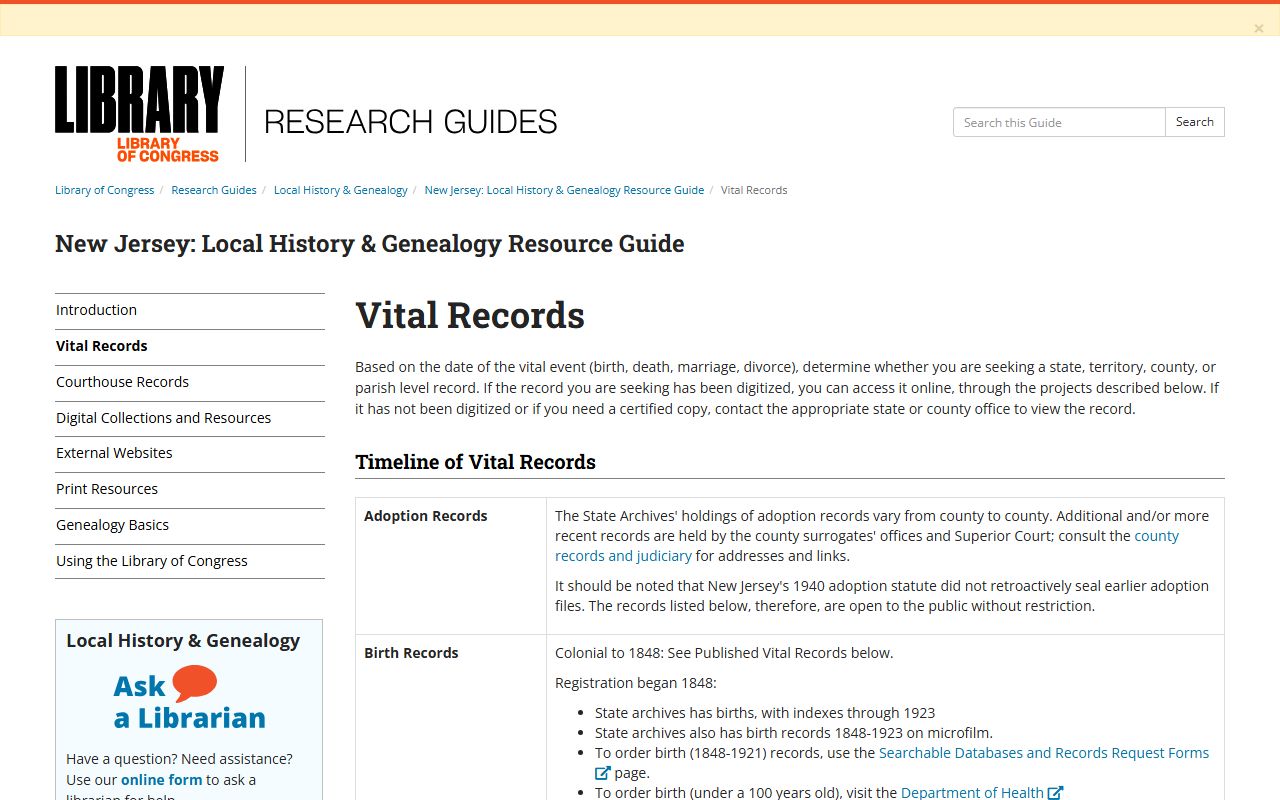
New Jersey has one of the longest runs of statewide vital record registration in the Mid-Atlantic. Registration began in May 1848. The state was only the second after Massachusetts to require it. The Library of Congress research guide outlines the full timeline of New Jersey vital records. It is a valuable resource for anyone doing genealogy work.
The 1848 to 1878 death database has over 301,128 records. Entries include the name, exact or approximate death date, and registration location. Some records have not yet been verified in the original books. The 1878 to 1900 database contains 628,584 records. This database also includes burial, reburial, transit, and disinterment permits marked as "BP," "RP," "TP," and "DI." The date on permits shows when the permit was issued, not the actual date of death.
The Reclaim The Records project obtained the New Jersey Death Index covering 1901 to 2017. Finding a name in the index lets you order the full death certificate from the state, which has more detail including the person's place of birth, parents' names, spouse, and burial location. The New Jersey State Library also holds genealogical reference tools, family histories, and local history collections useful for death record research.
For records from 1848 to 1917, order online from the State Archives. For records from 1918 to 1955, visit the State Archives in person or hire a genealogist. For genealogy copies from 1918 to 1978, order by mail from the Department of Health. For certified records from 1918 to present, order online from the Department of Health.
Death Records and New Jersey Law
New Jersey Revised Statutes Title 26 governs health and vital statistics in the state. Under N.J.S.A. 26:8-24, the State registrar has general supervision of vital record registration across New Jersey. The registrar prepares and supplies all forms used for recording. They examine certificates received, arrange and bind them, and keep a comprehensive index of all vital records.
Local registrars have duties under N.J.S.A. 26:8-25. They enforce laws about the disposal of dead bodies. They supply blank forms and examine each death certificate when presented. The local registrar makes complete copies and sends all originals to the State registrar. Any violations must be reported right away. Under N.J.S.A. 26:8-17, each local registrar appoints a deputy who can receive death certificates, issue burial permits, and issue copies when the registrar is absent.
These laws ensure that every death in New Jersey is properly recorded and that copies can be obtained through the right channels. The system has been in place since 1848.
Browse New Jersey Death Records by County
Each county in New Jersey has local registrars who keep death records. Pick a county below to find local offices, contact info, and resources for death records in that area.
Death Records in Major New Jersey Cities
Residents of major cities can get death records from their local registrar or the state office. Pick a city below to find local death record resources.